Emerging Market Assets

Hey Team,
In last week’s issue we explored ETHs dwindling cash flows due protocol upgrades that made blockspace more abundant and affordable for users and rollups.
In summary, you can break blockchain functions into 4 core components:
Execution
Settlement
Data availability
Consensus
Ethereum has moved 1&2 (the money makers) to L2s. This made companies like Arbitrum and Coinbase gobs of money. Meanwhile, Ethereum stakers are still handling 3&4 which are significantly less profitable. Many twitter users are very upset about this.
There are debates across twitter about whether this is a good or bad thing, if blobspace fees should go up, or if L1 use should be encouraged.
Many smart people are correctly pointing out that L1s have never been valued based on cash flows, and to do so would be selling them short (by a lot).
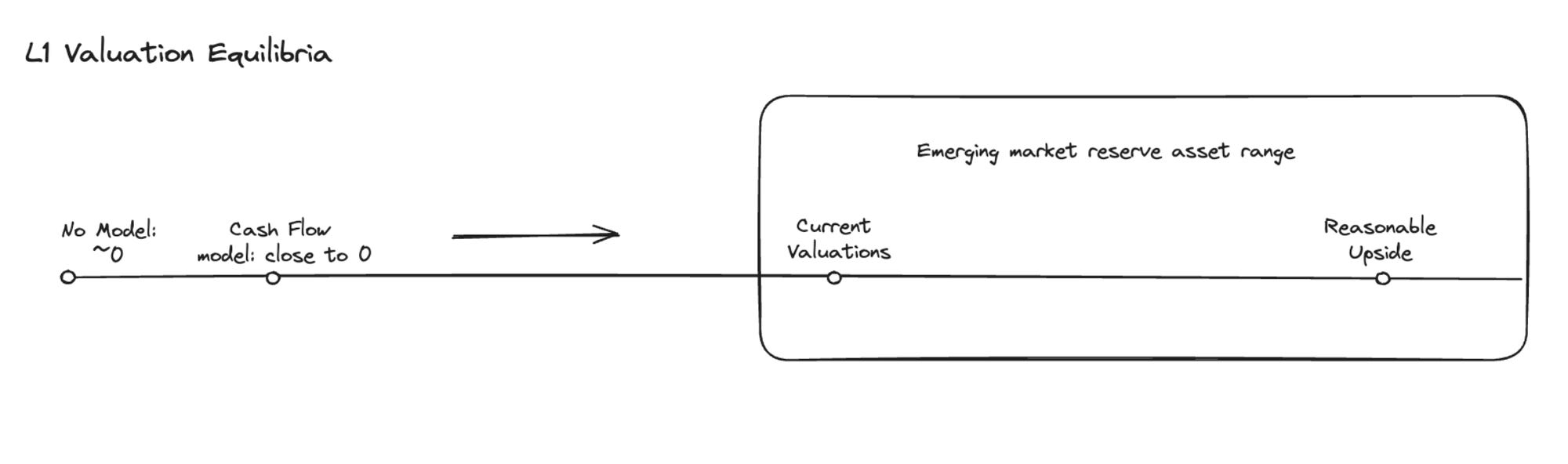
I hope that didn’t come across as pessimistic, because in this post I’m going to explain another avenue for value accrual to L1 assets. Viewing them as “emerging market reserve assets”.
If you’re like me, you remember the “alt L1 rotation” of 2021 fondly.
Alt L1 chains would launch incentives to provide liquidity to their DeFi apps. For example, Polygon and Avalanche both had massive incentive programs for simply using DEXs and lending protocols. Even without incentive programs, you could frontrun price moves on alt L1s coins by monitoring defillama to determine where stablecoins were bridging.
Like clockwork, as capital moved into alt L1s, the native assets moved up in price.
Why?
AVAX, MATIC, LUNA, SOL, and others were still highly unprofitable. What was the mechanism that caused the price appreciation?
As a blockchain network grows its economic activity, there are 3 mechanisms/properties that drive value to the underlying L1 asset:
The most liquid asset pair
The best collateral
“Community Money” & SOV
Contrast the above with an asset like $ATOM. The cosmos technology and appchain thesis seems as relevant as ever, but $ATOM is a cursed token because each appchain has their own native asset, $ATOM isn’t a commonly used liquidity pairing, and $ATOM isn’t viewed as an ideal collateral asset in lending markets.
It’s the same reason why Polygon got so much initial pushback last cycle for having their own native gas token and not using ETH.
These days, Arbitrum, Base, and other L2s equate “ethereum alignment” with using ETH as gas and further propagating ETH the asset. Even though Arbitrum and Optimism have their own tokens, the most liquid pairs are still with ETH.
Most Liquid Asset Pair
Lets say you are launching a new project with a token, what are you going to pair that token with when you are initializing your first liquidity pool?
Launching a memecoin on Solana? SOL
Launching a solidly fork on an L2? ETH
Doing whatever they’re doing over on Avalanche (tokenized chickens, perhaps)? AVAX
Let’s roll with the memecoin example.
If I launch a memecoin on Solana mocking the likeness of the sitting president of the US, I’d pair it with SOL and make a liquidity pool on a DEX like Raydium.
If degens want to buy my BODEN, they must first buy SOL. Then, they swap that SOL into an LP with BODEN, which increases both the market cap of BODEN and SOL. Even if that end user never holds more SOL than what they need for gas, they still are funneling capital directly into an asset that is paired with SOL.
This is reflexive in both directions.
As people buy Solana memecoins, SOL goes up in price. As SOL goes up in price, the assets paired primarily with SOL are also worth more (dollar denominated) even if no swaps occur in the BODEN/SOL pool.
For example,
if 1 BODEN = .01 SOL, & 1 SOL = $100, then 1 BODEN = $1
OR
if 1 BODEN = .01 SOL, & 1 SOL = $200, then 1 BODEN = $2
It works in reverse too.
So if money is flowing from USDC → SOL → memecoins paired with SOL, then everyone is getting rich on paper even if 90% of the end users are holding the memecoins and little SOL. SOL is capturing value because it is the liquid pair for the assets the capital is flowing to.
Of course, the idea is that there are (or will be) tokens that have actual value beyond being memecoins, and the same thought process applies to those.
Collateral Asset
If people expect it to go up they will store value in it and borrow against it.
If many people store value in it, it goes up.
Wait a second… This does seem like the ouroboros Vitalik was talking about.
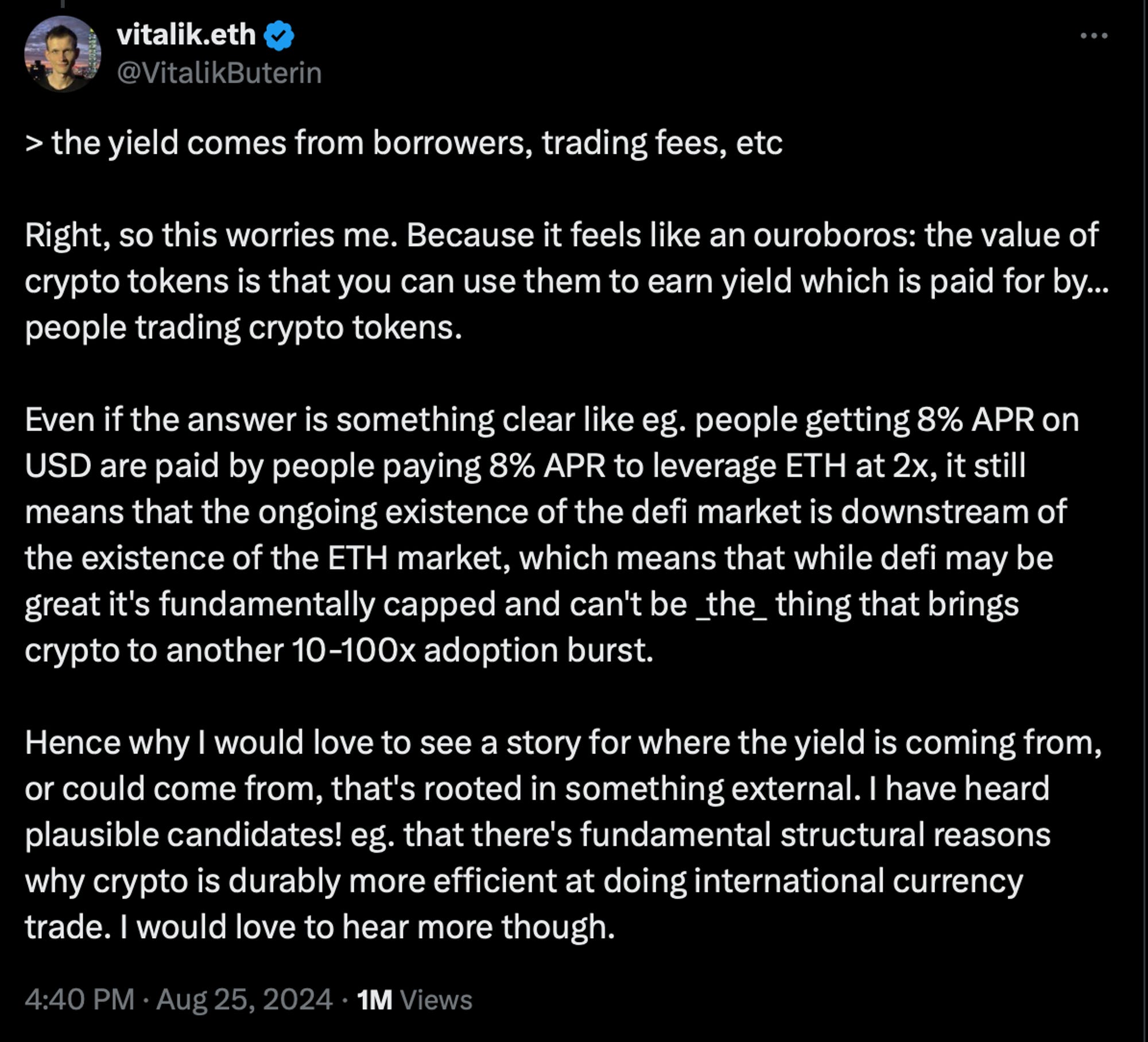
It is a bit self referential…
But as the onchain economy grows, the L1 asset(s) that is most liquid and ubiquitous across those economies will serve as the best collateral and money.
On chains like Ethereum, Arbitrum, and Base, ETH is the best collateral.
“Community Money” & SOV
BTC has never been and likely never will be “profitable”.
Despite that, Bitcoin dominance creeps higher and BTC market cap grows. That’s a sign that what ultimately matters for value capture of the major crypto assets is that they are seen as stores of value (SOV) and good sound money.
Increasing the availability and decreasing the cost of blockspace brings more opportunity for new applications onchain.
When gas goes from $0.25 to $0.0025, you don’t just get more swaps, borrowing and lending. You open up the door for entirely new applications that would not be economically viable with fees an order of magnitude higher.
If those novel applications (whatever they may be) are built in an ecosystem with ETH or SOL as that economy’s primary money, they benefit from that economic growth. That’s why despite hurting ETH’s short-term cashflows, making blockspace abundant and cheap is the right way forward.
Noteworthy Farms
Aerodrome: Aerodrome on Base is eating Uniswap’s lunch in terms of volume and TVL. It does have token incentives that you can farm. I’ve got a few concentrated liquidity positions on there. It’s worth checking out if you were planning on having some of those positions open.
Good Reads
Fun video of 0xMert building a Solana blockchain explorer (kinda) with Cursor AI
Disclaimer: None of this is to be deemed legal or financial advice of any kind. These are the *opinions* of a guy on the internet with a DeFi and IT background.